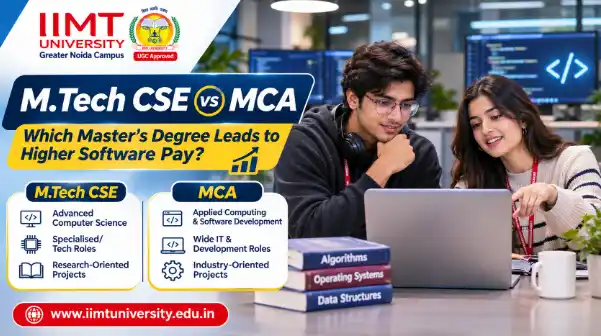
Choosing a postgraduate computing degree can influence the technical skills you develop, the jobs you pursue and your long-term career direction. For B.Tech CSE and BCA graduates, the MTech CSE vs MCA decision often comes down to one question: which degree offers better software career opportunities and salary potential?
Both qualifications can lead to careers in software development and information technology. However, they differ in eligibility, academic focus, and the kinds of projects students typically undertake.
Neither M.Tech CSE nor MCA automatically leads to a higher salary. Employers also evaluate programming ability, technical knowledge, projects, internships, experience and the requirements of individual roles.
This guide compares the two degrees for graduates considering higher education in Greater Noida, Delhi NCR and across India.
M.Tech in Computer Science and Engineering is generally an advanced engineering qualification that builds on undergraduate technical knowledge. MCA, or Master of Computer Applications, focuses on advanced computing and the development of software and IT applications.
| Factor | M.Tech CSE | MCA |
| Full Form | Master of Technology in Computer Science and Engineering | Master of Computer Applications |
| Academic Focus | Advanced computer science and engineering | Applied computing and software systems |
| Typical Background | Relevant engineering graduates | Eligible graduates from computing or other disciplines |
| Key Learning Areas | Advanced algorithms, AI/ML, systems, research | Programming, databases, software development, applications |
| Project Orientation | Advanced technical and research-oriented projects | Application development and industry-oriented projects |
| Career Pathways | Software engineering, specialised technical roles, research | Software development, application engineering, IT roles |
| Duration at IIMT Greater Noida | 2 years | 2 years |
Actual subjects and admission requirements vary by institution.
Neither degree consistently guarantees higher software pay. Salary depends more directly on the job, employer, technical ability and professional experience than on the degree title alone.
An M.Tech graduate with strong knowledge of algorithms, systems, or machine learning may be competitive for specialised technical roles.
An MCA graduate with excellent programming skills, production-quality projects and relevant internship experience may also qualify for well-paying software development positions.
| Factor | Why It Matters |
| Programming proficiency | Employers assess coding and problem-solving ability |
| Data structures and algorithms | Important in many technical interviews |
| Software projects | Demonstrate practical development experience |
| Internships | Provide exposure to workplace tools and practices |
| Technical specialisation | May influence eligibility for particular roles |
| Employer and location | Compensation varies across organisations and markets |
| Professional experience | Responsibilities and pay can change with experience |
When comparing salary claims, distinguish between an institution’s highest advertised package, the average or median compensation for a specific programme, and actual offers for the roles you want.
Ask institutions for recent programme-specific placement data, rather than assuming a university-wide maximum package represents typical earnings.
Eligibility is one of the biggest differences between the two programmes.
At IIMT University Greater Noida Campus, the published requirements are:
| Programme | Published Eligibility |
| M.Tech CSE | B.Tech in a relevant field from a recognised university with at least 60% marks |
| MCA | Three-year bachelor’s degree from a recognised university with at least 50% aggregate marks, with Mathematics at the 10+2 or undergraduate level |
The dedicated MCA programme page describes eligible applicants as graduates in Computer Applications, Computer Science or a related discipline with at least 50% marks.
Applicants from other academic backgrounds should confirm their eligibility directly with the admissions team.
The relevant official source is our admission criteria page.
M.Tech CSE typically explores advanced computing concepts in greater technical depth.
At IIMT University Greater Noida Campus, the M.Tech CSE programme highlights subjects including:
The programme also describes project and product design, research activities and opportunities to develop innovation-related skills.
This approach may appeal to engineering graduates interested in complex technical problems or further research.
MCA focuses on developing computing knowledge and applying it to software and IT systems.
Our MCA programme highlights:
Its learning approach includes laboratory work and practical assignments.
MCA may be particularly relevant to graduates who want to strengthen their software development and applied computing skills.
Both degrees can support careers in technology, although some roles require specific qualifications.
| Career Pathway | M.Tech CSE | MCA |
| Software Developer | Relevant | Relevant |
| Backend Developer | Relevant | Relevant |
| Full-Stack Developer | Relevant with appropriate skills | Relevant with appropriate skills |
| Data Analyst | Relevant | Relevant |
| AI/ML Engineer | Relevant with specialist skills | Possible with specialist skills |
| Cybersecurity Professional | Relevant with specialist skills | Possible with specialist skills |
| Research-Oriented Technical Roles | Often a closer academic fit | Depends on role and eligibility |
| Application Developer | Relevant | Often a close academic fit |
A degree alone does not establish eligibility for every vacancy.
For example, some recruiters accept B.Tech, M.Tech and MCA qualifications for software roles. Others specify a particular degree, branch or prior experience.
Students should review actual job descriptions for their preferred career path before choosing a postgraduate programme.
For a B.Tech CSE graduate, M.Tech CSE is often a natural option for advanced engineering study, technical specialisation or research.
However, a B.Tech graduate may also consider MCA where eligible and where its applied curriculum better matches a specific career goal.
For a BCA graduate, MCA is commonly a more direct postgraduate pathway because it builds on computer applications and programming knowledge.
A BCA graduate should not assume direct eligibility for M.Tech CSE. Institutions may require a relevant engineering degree and other qualifications.
The right higher degree after BCA or BTech depends on your academic background, career interests and the programme’s eligibility rules.
For mainstream software development, either degree can be relevant.
What matters is whether you graduate with the skills employers expect.
For example, a student interested in backend development should build competence in programming, databases, APIs, testing, version control and software architecture.
Someone interested in machine learning should focus on programming, mathematics, statistics, model evaluation and practical projects.
Choose the programme that develops the skills required for your preferred role, rather than relying only on its title.
Compare the total cost of attendance, not just annual tuition.
Include tuition, mandatory charges, accommodation, travel, equipment and other applicable expenses.
Also consider the time needed to complete the degree and the opportunity cost of delaying full-time employment.
At IIMT University Greater Noida Campus, the published fee structure lists programme-wise charges for both M.Tech CSE and MCA. Review the official fee structure for current amounts and confirm the complete payable total with admissions.
A higher fee does not automatically mean stronger career outcomes.
Students considering postgraduate computing education in Delhi NCR can compare both programmes at our Greater Noida Campus.
Our M.Tech CSE programme emphasises advanced technical subjects, research and innovation-oriented projects.
Our MCA programme emphasises applied computing, software development and data-related skills.
Both are listed as two-year, full-time programmes, allowing students to compare their academic direction without a difference in standard programme duration.
The M.Tech CSE programme describes industry-based projects, workshops, seminars and interaction with industry experts.
The MCA programme highlights laboratories, assignments and industry-focused learning.
These activities can help students connect technical knowledge with practical problems. Applicants should review current syllabuses, project opportunities and programme-specific career support before enrolling.
Our campus is located in Knowledge Park III, Greater Noida, Uttar Pradesh.
Students can consider the wider Delhi NCR technology ecosystem when exploring professional events, technical communities and potential internship opportunities.
However, geographic proximity does not guarantee an internship, placement or particular salary.
Compare the two programmes using your academic eligibility, preferred career path, curriculum interests and budget.
Explore M.Tech CSE at IIMT University Greater Noida
Explore MCA at IIMT University Greater Noida
You can also review our admission overview before applying.
Confirm current eligibility, fees and selection requirements directly with the university.
The M.Tech CSE vs MCA decision should be based on your academic background, technical interests and career goals—not assumptions about which degree commands a higher salary.
M.Tech CSE may suit engineering graduates seeking deeper technical study or research-oriented work. MCA may suit eligible graduates seeking advanced software and application-development skills.
Whichever programme you choose, strong projects, practical experience and continuous learning will remain important to your career development.
Yes. Individual MCA graduates may earn more than M.Tech graduates, depending on their roles, employers, skills and experience. Neither qualification guarantees a higher salary.
Eligibility varies by institution. At IIMT University Greater Noida Campus, the published M.Tech CSE requirement specifies a B.Tech degree in a relevant field with at least 60% marks.
Yes, where they meet employer requirements. Some companies accept MCA qualifications for software development roles, while others specify particular degrees.
Difficulty depends on the curriculum and the student’s background. M.Tech CSE may involve more advanced engineering theory and research, while MCA also requires substantial programming and computing skills.
No. Relevant mathematical knowledge, programming ability, projects and experience are also important. Some specialist or research positions may prefer advanced qualifications.
M.Tech CSE is often more closely aligned with engineering research. However, MCA graduates may also pursue eligible research or higher-study pathways, depending on institutional requirements.
Age alone does not determine career success. Applicants should check any institution-specific eligibility rules and consider their professional goals and financial circumstances.
Both qualifications may provide routes to doctoral study where the applicant meets the relevant university’s eligibility, entrance and research requirements.