A career in media no longer depends only on working in a newsroom or advertising agency. Businesses need professionals who can manage digital campaigns, create engaging content, build brand reputations and communicate across multiple platforms.
For graduates considering a practical postgraduate qualification, understanding PG Diploma in Digital Media scope can help them choose a suitable career pathway.
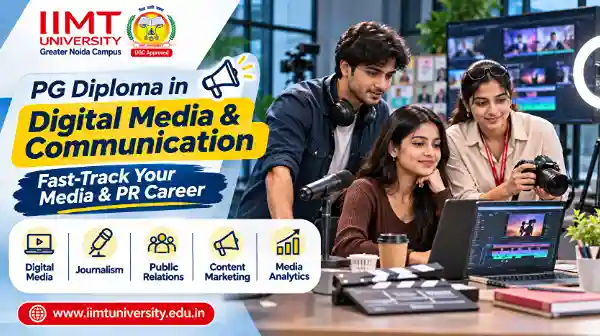
A Post Graduate Diploma in Digital Media & Communication can help graduates develop skills in social media strategy, digital journalism, public relations, content marketing and multimedia production.
This guide explains the career opportunities, eligibility, practical skills and differences between a postgraduate diploma and a traditional master’s degree, with a focus on Greater Noida and Delhi NCR.
A PG Diploma in Digital Media & Communication prepares graduates to explore careers in digital marketing, content production, public relations, online journalism and corporate communication.
Unlike programmes focused mainly on academic theory, an industry-oriented diploma may emphasise practical projects, digital tools and professional communication.
Graduates can explore opportunities with digital agencies, news organisations, brands, production companies and corporate communication teams.
However, employment depends on practical ability, portfolio quality, prior experience and employer requirements. Completing a diploma does not guarantee a particular job or salary.
This qualification may suit graduates who want to develop specialised communication skills without committing immediately to a longer postgraduate degree.
| Student Profile | Potential Benefit |
| BAJMC graduates | Developing advanced digital production and media skills |
| BBA or B.Com graduates | Exploring marketing, branding and corporate communication |
| BA graduates | Building practical writing, media and content skills |
| BCA or technical graduates | Moving towards digital platforms, content analytics or technology communication |
| Working professionals | Updating skills or exploring a career transition |
Students should compare the curriculum with their existing knowledge before enrolling. A postgraduate diploma is most valuable when it adds capabilities that their undergraduate degree or work experience did not already provide.
Students learn how digital platforms support communication and brand awareness.
Relevant skills include content calendars, audience research, campaign planning, engagement analysis and platform-specific storytelling.
Digital journalism combines reporting with online publishing, mobile journalism, video production and multimedia storytelling.
Students may practise scripting, interviewing, editing and adapting content for different platforms.
Digital PR involves managing communication across websites, social platforms and other online channels.
Professionals need writing skills, audience awareness, reputation management and the ability to respond appropriately during communication challenges.
A digital marketing PG diploma may cover campaign planning, search marketing, paid advertising, audience measurement and performance reporting.
Students should check whether a programme includes practical assignments using current tools rather than relying only on theoretical explanations.
Artificial intelligence and automation are changing how media professionals research, produce and distribute content.
Students should learn to use these tools responsibly while maintaining editorial accuracy, originality, privacy and appropriate human review.
| Career Role | Typical Work |
| Digital Content Executive | Creating and publishing online content |
| Social Media Executive | Managing posts, engagement and campaigns |
| Content Writer or Copywriter | Writing editorial and promotional material |
| Digital PR Executive | Supporting online reputation and communication |
| Multimedia Journalist | Reporting and producing digital news content |
| Video Producer or Editor | Developing and editing video content |
| Digital Marketing Executive | Supporting digital campaigns and performance tracking |
| Media Planning Assistant | Coordinating advertising and platform plans |
These are potential entry points. Roles such as digital marketing manager, creative director, or PR manager typically require substantial professional experience.
A postgraduate diploma and a master’s degree serve different educational purposes.
| Factor | PG Diploma | Master’s Degree |
| Duration | Often around one year | Commonly two years |
| Learning Focus | Specialised, practical skills | Broader or deeper academic study |
| Projects | Frequently industry-oriented | Depends on the programme |
| Qualification | Postgraduate diploma | Master’s degree |
| Suitable For | Targeted skill development or career transition | Advanced academic study or roles requiring a master’s degree |
A diploma is not automatically equivalent to a master’s degree.
Students considering academic careers, research or jobs with specific qualification requirements should check whether a postgraduate diploma meets those requirements.
A shorter programme can be useful, but the decision should depend on curriculum quality, credential recognition, practical exposure, and long-term goals.
Eligibility depends on the institution and programme.
At IIMT University Greater Noida Campus, the dedicated PG Diploma in Digital Media & Communication page states that applicants need a bachelor’s degree in any stream with at least 45% marks. It also lists an age limit of up to 35 years, provisional admission for final-year students and an interview conducted by India Today Media Institute.
However, the university’s general admission-criteria page lists a minimum of 50% marks for PG Diploma in Digital Media.
Applicants should confirm the currently applicable eligibility threshold, age requirements and selection process directly with the admissions team before applying.
Yes, it may be suitable for graduates and professionals moving from other fields into media and communication.
For example, a Commerce graduate interested in branding could develop content strategy and campaign-planning skills. A graduate with technical experience might explore digital analytics, multimedia production or technology-focused communication.
Career switchers should build evidence of their new abilities through practical projects.
A useful starter portfolio could contain a social media campaign plan, two published articles, a short edited video and a basic campaign performance report.
This provides employers with examples of work rather than relying on a qualification alone.
At IIMT University Greater Noida Campus, our Post Graduate Diploma in Digital Media & Communication is presented as a 12-month programme developed with India Today Media Institute.
The programme combines nine months of training with a three-month internship component.
The official programme page describes two credentials: a postgraduate diploma from IIMT University and a professional certificate from India Today Media Institute.
Its curriculum includes applied journalism, social media management, advertising, content writing, mobile journalism, digital PR, influencer marketing, digital media planning, data journalism and emerging technologies.
These areas help connect communication fundamentals with the practical demands of digital platforms.
The programme describes studio simulations, digital storytelling, video editing, campaign projects and training supported by media professionals.
It also advertises a three-month assured internship with the Tak digital properties of India Today Group.
Applicants should confirm the current internship terms, allocation process, location and applicable conditions in writing. An internship opportunity is not a guarantee of subsequent employment.
Our campus is located in Knowledge Park III, Greater Noida, Uttar Pradesh.
For students interested in media and communication, the wider Delhi NCR region provides a useful setting for exploring professional events, agencies, production businesses and industry networks.
Location should be considered alongside programme content, travel arrangements and the actual opportunities available to students.
Students comparing postgraduate options should review the complete curriculum, credential details, fees, eligibility, and internship conditions.
Explore the PG Diploma in Digital Media & Communication at IIMT University Greater Noida Campus
You can also review our admission overview, admission criteria and published fee structure.
Confirm the latest admissions requirements and programme costs before submitting your application.
A postgraduate qualification can provide structure, but career development also requires consistent practice.
Start by choosing an area of interest, such as content marketing, digital journalism, video production or public relations.
Then build a portfolio, learn relevant tools and apply for internships or entry-level opportunities.
For digital marketing roles, practise interpreting campaign performance rather than simply memorising terminology. For journalism roles, focus on research, verification and clear storytelling.
Review job descriptions regularly to understand which skills employers actually request.
The scope of a PG Diploma in Digital Media & Communication includes digital marketing, online journalism, public relations, content creation and multimedia production.
A practical postgraduate diploma may be useful for graduates seeking specialised skills or professionals exploring a career change.
Before enrolling, compare the curriculum, qualification, industry exposure, internship conditions and career relevance. The right programme should help you develop demonstrable skills aligned with your professional goals.
Graduates may explore roles in content marketing, social media, search marketing, campaign coordination and digital analytics. Opportunities depend on skills and experience.
Yes, BAJMC graduates may be eligible for relevant postgraduate diploma programmes, subject to the institution’s admission criteria.
Neither is universally better. A diploma may suit targeted practical training, while a master’s degree may be more appropriate for deeper academic study or roles requiring that qualification.
Yes, many programmes accept graduates from different disciplines. Check the specific eligibility and selection requirements.
Yes. Graphic design supports digital campaigns, social media content, advertising and visual communication. Some roles require additional specialist design training.
No. A diploma may provide training and career support, but employment depends on employer selection, skills, vacancies and individual performance.
Digital PR focuses on reputation, relationships and communication, while digital marketing focuses more broadly on reaching audiences and supporting measurable marketing objectives. The two fields often overlap.
They may be eligible, but should confirm the class schedule, attendance requirements and programme format before applying.